
Keep your partnership firm compliant with Legal Startup. A dedicated expert tracks tax due dates, files the income tax return, coordinates the tax audit, handles TDS and GST returns, and updates the Registrar of Firms and your partnership deed when things change.
Free call & custom quote · Professional fee + government fee, if any
Partnership firm compliance in India means the tax, accounting and registration duties a firm must follow under the Indian Partnership Act, 1932, the Income-tax Act and GST law. A partnership firm has no annual return to file with the Registrar, but it must keep books, file an income tax return every year, pay advance tax, and file TDS and GST returns where they apply.
Last updated: October 2026. Due dates, limits and forms can change or be extended, and Registrar of Firms rules vary by state, so we confirm the current position before filing. This page is general information, not legal advice.
A partnership firm is a business owned by two or more partners under a partnership deed, governed by the Indian Partnership Act, 1932. It is taxed as a separate entity and has unlimited liability for its partners. Its compliance is mainly tax and record-keeping, rather than the yearly ROC filings that an LLP or company must make.
The core duties are maintaining books of accounts, applying for a PAN, paying advance tax, filing the firm's income tax return and, where the limits apply, getting a tax audit done. If the firm deducts tax at source or is registered under GST, it also files TDS and GST returns. Employers may have PF, ESI and professional tax duties as well.
The firm can also register with the Registrar of Firms of its state. Registration is optional, but an unregistered firm has limits on enforcing rights in court, and a registered firm must report changes in partners, name or place of business. For tax filing, visit the Income Tax e-filing portal, and for GST the GST portal. If you are comparing structures, see our LLP compliance page.
Important limits and timelines every partnership firm should know.
Tax, GST and registrar filings for a partnership firm.
The firm's yearly return of income.
Required above the turnover and receipt limits.
Tax paid in instalments through the year.
Applicable if the firm deducts tax or is registered.
Registration and notices of change.
The document that governs partner rights.
Not sure which filings your firm owes? Share your PAN and firm details and our experts will check it free of charge.
Why firms keep their filings and records in order.
On-time returns and advance tax avoid avoidable charges.
Clean books and matching returns reduce the chance of queries.
Banks ask for filed returns and audited accounts.
A proper deed supports partner interest and remuneration claims.
Updated records show who owns and owes what.
A registered firm can enforce its rights in court more easily.
Share documents from anywhere in India, no office visit needed.
From compliance check to filed returns, here is how our online partnership firm compliance works.
Timelines depend on how ready your accounts are and on pending years. Not to scale.
We check the partnership deed, PAN, GST status, past returns and any notices to see what is pending.
We take sales and purchase records, bank statements, partner capital and drawings, and confirm whether a tax audit applies.
We work out profit, partner interest and remuneration within the permitted limits, and the tax and advance tax due.
ITR-5, TDS and GST returns are drafted and shared with the partners for review.
Returns are filed on the respective portals and any tax or fee is paid.
You receive acknowledgements and a calendar of upcoming due dates.
Keep these ready to avoid delays. Our expert will confirm the exact list for your firm.
The total cost of partnership firm compliance depends on turnover, the number of transactions, whether a tax audit or GST filing applies, and how many years are pending. It generally has three parts:
Income tax, interest and any late fee are payable to the government. Registrar of Firms fees vary by state. We confirm current amounts before filing.
Our fee depends on turnover, volume of transactions and years pending. Call free for a custom quote before you pay anything.
Tax audit, bookkeeping, GST returns, deed drafting and dissolution are charged separately.
We share a clear, itemised quote before you begin – no hidden charges. Get your free quote →
Choose the situation that matches your firm, or call free for a custom quote.
Your firm is up to date and you want every year filed on time.
Returns are overdue or the firm has received a tax notice.
A partner, address or name has changed, or you want to register or close the firm.
Our professional fee is quoted after a free call. Government fees, tax and any late fee are separate. Not sure which option fits? Ask for a free compliance check.
Every partnership firm in India has tax and record-keeping duties, whatever its size.
Shops, distributors, agencies and professional partnerships.
Firms where partners are relatives and records are often informal.
Regular returns apply once registered or deducting tax.
Every change should be reflected in the deed and the register.
Lenders review returns, audited accounts and the deed.
Speak to us quickly to limit late fees and fix the record.
A quick view of how the compliance load differs. Ask us which structure suits your business.
| Point | Partnership firm | LLP |
|---|---|---|
| Governing law | Indian Partnership Act, 1932 | LLP Act, 2008 |
| Annual registrar filing | None | Form 11 and Form 8 |
| Income tax return | ITR-5 | ITR-5 |
| Registration | Optional with Registrar of Firms | Mandatory with MCA |
| Liability of partners | Unlimited | Limited to contribution |
A due date calendar and an updated deed prevent most compliance problems.
Filing is one part of staying compliant. Here is how to keep the record clean.
Keep filing receipts and signed accounts with the firm's records.
Record sales, expenses and partner transactions through the year.
Amend the deed and notify the Registrar when partners, name or address change.
Note the next advance tax and return dates ahead of time.
Need other support for your business? Visit our Legal Startup home page to see our full list of services.
Quick answers on partnership firm compliance in India.
Partnership firm compliance is the set of tax, accounting and registration duties a firm must follow under the Indian Partnership Act, 1932, the Income-tax Act, GST law and other applicable laws. The core duties are maintaining books, filing the income tax return, paying advance tax and filing TDS and GST returns where applicable.
No. Unlike an LLP, a partnership firm has no yearly annual return to file with the Registrar of Firms. Registration itself is optional, but notice of changes in partners, name or place of business should be given to the Registrar if the firm is registered.
Registration is not compulsory, but an unregistered firm faces limits on enforcing rights in court, including suits against third parties to enforce a contract. Most firms therefore register with the Registrar of Firms of their state.
A partnership firm generally files ITR-5. The usual due date is 31 July, and 31 October where the firm's accounts are required to be audited, subject to any extension announced by the Income Tax Department.
A tax audit under section 44AB generally applies when business turnover exceeds ₹1 crore, or ₹10 crore if cash receipts and payments are within the prescribed limit, and in certain cases under presumptive taxation. We check the limits for your firm each year.
A late filing fee under section 234F can apply, along with interest on unpaid tax, and a firm that misses a required tax audit can face a penalty under section 271B. Amounts and rules can change, so we confirm the current position.
Interest on partners' capital is allowed up to 12 percent simple interest a year, and remuneration to working partners is allowed within the limits of section 40(b), if the partnership deed authorises them. These limits are why the deed must be drafted carefully.
Only if its turnover crosses the applicable GST threshold, or it makes supplies that require registration. A registered firm files periodic GST returns and an annual return where applicable. We check whether registration applies to your firm.
Admission, retirement or death of a partner, change in firm name, change of principal place of business and opening or closing of a branch. A registered firm gives notice to the Registrar of Firms, and the partnership deed is amended or a supplementary deed is made. Forms and time limits vary by state.
It depends on liability, funding plans and cost. A partnership has unlimited liability and lighter filings, while an LLP gives limited liability but has annual ROC filings. We compare both for your business before you decide.
Is your partnership firm due for a return or behind on past years? Speak to our compliance expert today – the compliance check and the quote are free.
Tell us what you need and our team will get back to you with the right guidance.
Legalstartup ke certificates, registrations aur recognitions jo hamari credibility dikhate hain.

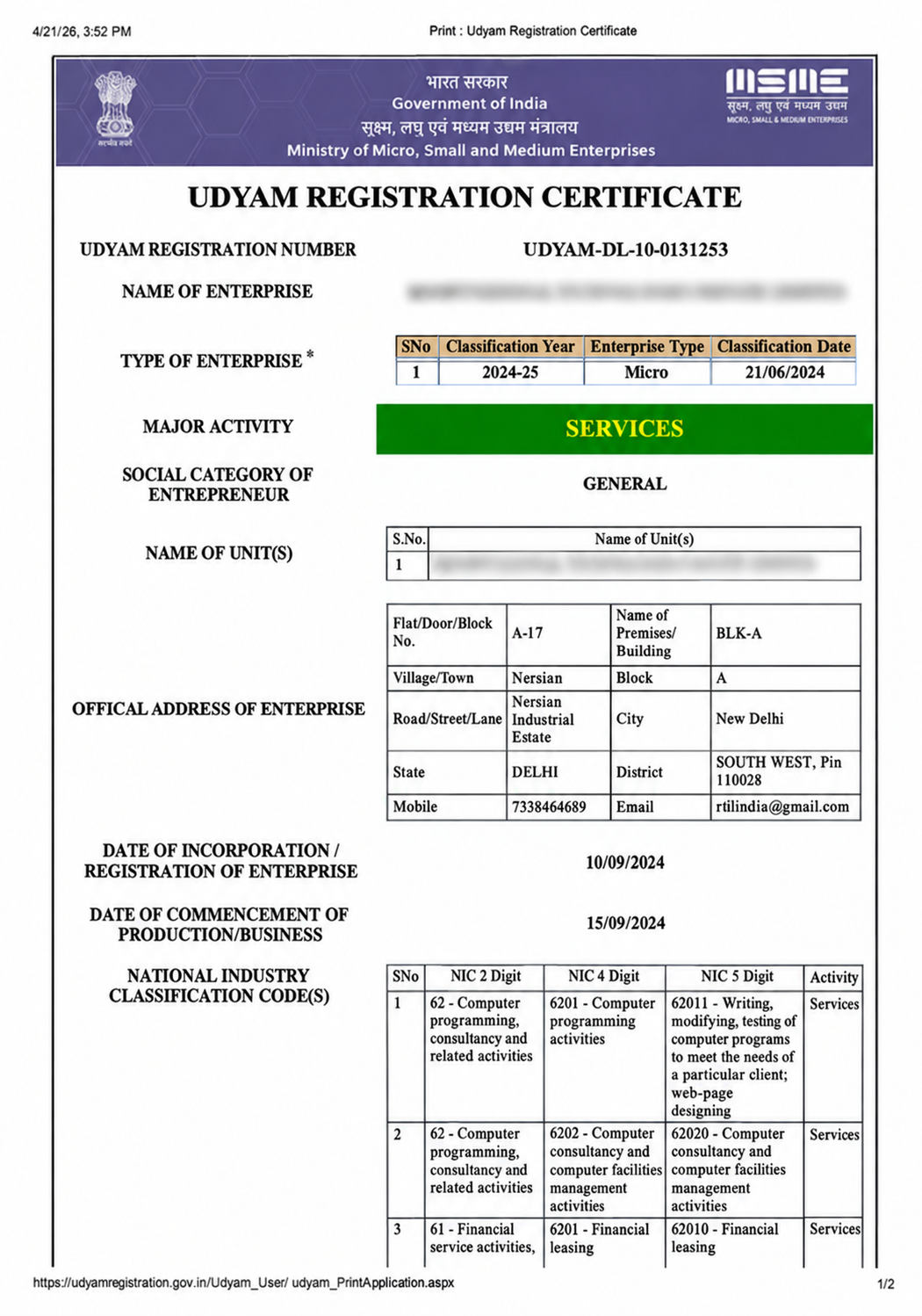





"Explore how Legalstartup has helped businesses reach new heights as their trusted partner."

Thousands of businesses and founders trust LegalStartup.