
File your GSTR 9 annual return with Legal Startup. A dedicated GST expert checks whether you need to file, reconciles GSTR-1, GSTR-3B and your books, reviews input tax credit, and files GSTR-9 (and GSTR-9C where applicable) on the GST portal.
Free call & custom quote · Fee shared before you pay anything
GSTR 9 annual return is the yearly return that regular GST taxpayers file under Section 44 of the CGST Act, 2017, summarising a financial year's outward supplies, inward supplies, input tax credit and tax paid.
Last updated: October 2026. Due dates, turnover limits, late fee rates and forms are set by the GST authorities and can change, so we confirm the current position before you proceed.
GSTR-9 is a consolidated return for one financial year. It brings together the figures you reported month by month or quarter by quarter in GSTR-1 and GSTR-3B, so the tax department can see your full-year sales, purchases, ITC claimed and tax paid in one place.
It is not a simple copy of earlier returns. Differences between GSTR-1, GSTR-3B, the books of accounts and GSTR-2B usually surface at this stage, and any additional tax or ITC reversal found must be dealt with. Since GSTR-9 cannot be revised once filed, preparation matters more than the filing itself.
For official forms and filing, visit the GST portal (gst.gov.in) and the CBIC GST website (cbic-gst.gov.in).
GSTR-9 has six parts. Some tables are optional for smaller taxpayers.
Basic details and the year's supplies.
ITC claimed, reversed and available.
Tax paid and carried-over items.
Disclosures that complete the return.
Not sure whether you must file, or whether GSTR-9C applies? Tell us your aggregate turnover and we will advise free of charge.
An accurate annual return protects your ITC and your compliance record.
Meet the annual filing requirement under Section 44 and avoid late fee and notices.
Reconciling GSTR-1, GSTR-3B and the books before filing reduces the chance of queries later.
Identify ITC that is ineligible, unclaimed or needs reversal while it can still be handled.
Banks, lenders and tenders often ask for filed GST returns as proof of turnover.
Your accounts and GST filings tell the same story, which helps audit and GSTR-9C.
Documented reconciliations make it easier to respond to departmental scrutiny.
From applicability check to filed return.
Timelines depend on the volume of transactions and the quality of your records. Not to scale.
We check your registration type, aggregate turnover and financial year to confirm whether GSTR-9 is mandatory or optional and whether GSTR-9C applies.
You share sales and purchase registers, ledgers and the GST login details or downloads we need for the year.
We match outward supplies with the books and ITC claimed with GSTR-2B and purchase records, and list every difference.
We fill the GSTR-9 tables, HSN summary and disclosures, and explain differences, additional liability or reversals before anything is submitted.
After your approval, we pay any additional tax or late fee through the correct route and file GSTR-9 on the GST portal.
If your turnover is above Rs 5 crore, we help with the reconciliation statement against your financial statements.
Keep these ready to avoid delays. Our expert will confirm the exact list for your case.
The cost has separate parts, and we show them separately so there are no surprises:
Our fee depends on the volume of invoices, the financial year, the state of your returns and whether GSTR-9C is needed. Call free for a custom quote before you pay anything.
Any additional tax, interest or late fee is payable to the government and is separate from our fee. It depends on your figures and the filing date.
Pending GSTR-1 or GSTR-3B filing, detailed ITC reconciliation and bookkeeping clean-up are quoted only if you need them.
We share a clear, itemised quote before you begin. Get your free quote →
Choose the situation that matches your business, or call free for a custom quote.
Businesses with turnover where GSTR-9 is required or chosen voluntarily.
Taxpayers with aggregate turnover above Rs 5 crore.
Missed due date, pending GSTR-1 or GSTR-3B, or mismatch notices.
Our professional fee is quoted after a free call. Government dues are separate. We do not promise outcomes with the tax authorities. Not sure which option fits? Ask for a free consultation.
A quick view of the GST annual filings.
| Form | Who files | Turnover | Purpose | Nature |
|---|---|---|---|---|
| GSTR-9 | Regular taxpayers | Optional up to the notified limit (Rs 2 crore in recent years); mandatory above | Annual summary of supplies, ITC and tax paid | Return; cannot be revised once filed |
| GSTR-9C | Regular taxpayers above the limit | Above Rs 5 crore | Reconcile GSTR-9 with financial statements | Self-certified reconciliation statement |
| GSTR-4 | Composition taxpayers | Within composition limits | Annual return for composition scheme | Return; filed instead of GSTR-9 |
Most problems come from unreconciled data and rushed filing near the due date.
Filing the return is one part of staying GST compliant.
Keep the acknowledgement and filed GSTR-9 PDF with your records for audit and future reference.
If your turnover is above Rs 5 crore, file the reconciliation statement for the same financial year.
Retain reconciliations, invoices and ledgers for the period required under GST law.
If the department raises a query or notice, we guide you on the reply and supporting documents.
Matching sales and ITC every month makes the next annual return faster and less error-prone.
Quick answers on GSTR 9 annual return filing in India.
GSTR-9 is the annual return that regular GST taxpayers file under Section 44 of the CGST Act, 2017. It consolidates the outward and inward supplies, tax paid, input tax credit, refunds, demands and HSN summary reported through GSTR-1 and GSTR-3B during a financial year.
Regular taxpayers registered under GST must file it, subject to the turnover exemption notified for the year. Composition taxpayers, input service distributors, casual taxable persons, non-resident taxable persons and TDS or TCS deductors are not required to file GSTR-9.
The due date is generally 31 December following the end of the financial year, so for FY 2025-26 it is 31 December 2026 unless the government extends it. Extensions have been notified in some past years, so we confirm the current date before filing.
For recent financial years, filing GSTR-9 has been optional for taxpayers whose aggregate turnover is up to Rs 2 crore. Taxpayers above that limit must file it. The exemption is notified year by year, so we check the notification for your financial year.
GSTR-9 is the annual return. GSTR-9C is a reconciliation statement that compares the turnover and tax in GSTR-9 with the audited financial statements. It applies to taxpayers whose aggregate turnover is above Rs 5 crore and is self-certified for recent years.
A late fee applies for every day of delay, split equally between CGST and SGST, up to a cap linked to turnover in the state or union territory. The daily rate and cap depend on your turnover slab as notified, so we confirm the exact figure before you file.
No. Once GSTR-9 is filed, it cannot be revised or edited on the GST portal. That is why we reconcile GSTR-1, GSTR-3B, the books and ITC data carefully before submission.
It has six parts: basic details, outward and inward supplies, input tax credit, tax paid, prior year transactions declared in the current year, and other information such as refunds, demands, deemed supplies, HSN summaries and late fee. Some tables are optional for smaller taxpayers.
Reconcile sales in GSTR-1 and GSTR-3B with the books, and ITC claimed in GSTR-3B with GSTR-2B and purchase records. Also check e-invoice and e-way bill data, credit notes, amendments and reversals so the annual figures match.
Additional tax liability found during annual return preparation is generally paid in cash through the electronic cash ledger using Form DRC-03, and it cannot be paid from the credit ledger. The correct route depends on the case, so we confirm it before you pay.
Need help with your GSTR 9 annual return? Speak to our GST expert today – the consultation and the quote are free.
Tell us what you need and our team will get back to you with the right guidance.
Legalstartup ke certificates, registrations aur recognitions jo hamari credibility dikhate hain.

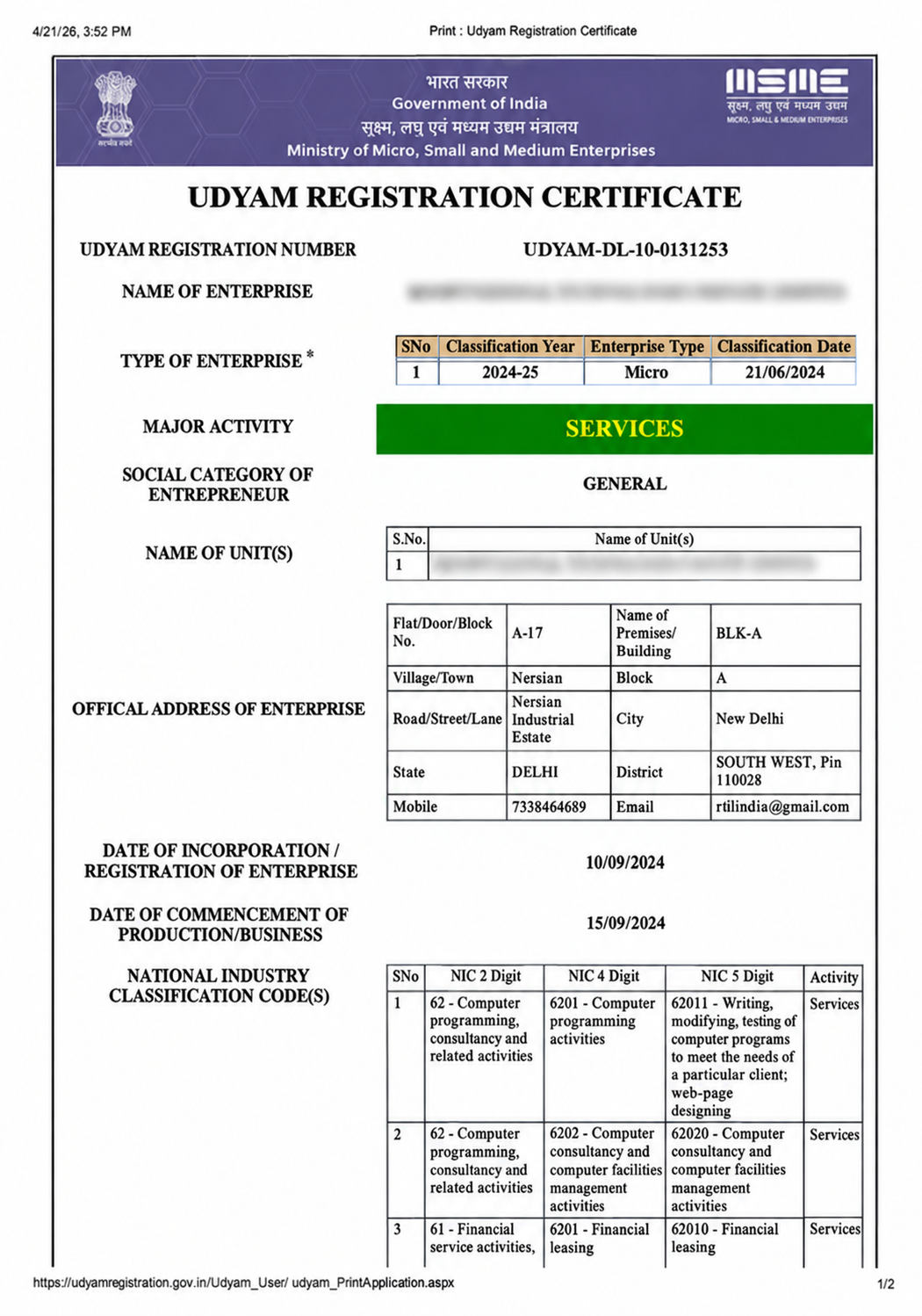





"Explore how Legalstartup has helped businesses reach new heights as their trusted partner."

Thousands of businesses and founders trust LegalStartup.