

Views: 8
Starting a business in India now comes with real government support, yet many founders are unsure what that support actually covers. Startup India benefits include tax relief, faster patent and trademark processing, simpler compliance, procurement relaxations and access to funding schemes. Most of these advantages are not automatic, though. You must first be recognised by the Department for Promotion of Industry and Internal Trade (DPIIT), and some benefits need a separate approval on top of that.
This 2026 guide explains every major benefit in simple language, who can claim it, what the revised rules say and how to apply. By the end, you will know whether DPIIT recognition suits your business and what to do next.
Quick Summary
- What it is: A government initiative that gives eligible new businesses support on tax, funding, intellectual property and compliance.
- Who can apply: Private limited companies, LLPs, registered partnership firms and cooperative societies, up to 10 years old, with turnover not above ₹200 crore (Deep Tech startups: 20 years and ₹300 crore).
- Biggest advantages: The biggest Startup India benefits are a possible three-year tax holiday, no angel tax, 80% off patent filing fees, 50% off trademark filing fees, self-certification and access to funding schemes.
- Cost of recognition: Nil. The government charges no fee for the DPIIT certificate.
- Important caution: Each of the Startup India benefits below has its own conditions. Recognition alone does not guarantee any single one.
Table of Contents
- 1 What Is Startup India?
- 2 What Are the Startup India Eligibility Criteria?
- 3 Top 10 Startup India Benefits
- 4 DPIIT Recognition Benefits: What Starts Immediately and What Needs Extra Approval
- 5 Startup India Tax Exemption and Funding Support Explained
- 6 Funding Support
- 7 Startup India Registration Process (Step by Step)
- 8 Frequently Asked Questions
What Is Startup India?
Startup India is a flagship initiative launched by the Government of India in 2016 to build a strong ecosystem for innovation and entrepreneurship. It is run by DPIIT under the Ministry of Commerce and Industry. The programme rests on three ideas: simpler rules for new businesses, financial support and incentives, and stronger links between industry, academia and young founders.
It helps to separate two terms that founders often mix up. Startup India is the initiative and its online portal. DPIIT recognition is the certificate that proves your business is an eligible startup, and this certificate unlocks most Startup. Creating an account on the portal alone gives you learning and networking resources, but not the statutory advantages.
The rules also changed this year. On 4 February 2026, DPIIT notified a revised startup framework (G.S.R. 108(E)). It doubled the turnover limit from ₹100 crore to ₹200 crore, created a new Deep Tech Startup category and opened recognition to cooperative societies. If you read older articles, check their figures against these updates before relying on them.
What Are the Startup India Eligibility Criteria?
Under the 2026 framework, an entity qualifies for recognition when it meets all of the following conditions.
| Criterion | General startup | Deep Tech startup |
|---|---|---|
| Entity type | Private limited company, LLP, registered partnership firm or cooperative society | Same |
| Maximum age | Up to 10 years from incorporation or registration | Up to 20 years |
| Maximum turnover | Not above ₹200 crore in any financial year since incorporation | Not above ₹300 crore |
| Nature of business | Innovation, development or improvement of products, processes or services, or a scalable model with high potential for jobs or wealth creation | Same, plus high R&D spending and significant new intellectual property |
| Origin | Not formed by splitting up or reconstructing an existing business | Same |
A few practical points follow from this table:
- Sole proprietorships and HUFs cannot get recognition. A proprietor must incorporate first.
- A plain trading or service business with no innovation or scalability angle may be refused.
- Deep Tech applicants must give extra proof of R&D and intellectual property.
If you have not incorporated yet, you can choose between private limited company registration, which suits founders planning to raise investment, and LLP registration, which carries lighter compliance. Both are eligible entity types.
Remember that recognition criteria and benefit criteria are different. The eligibility rules for specific can be tighter than the basic recognition test, especially for the tax holiday.
Top 10 Startup India Benefits
Here are the ten advantages most founders look for. Each has its own conditions, explained alongside.
1. Free DPIIT Recognition
The Certificate of Recognition costs nothing, is issued digitally and carries a unique DPIIT number. Think of it as the key that opens the other Startup India benefits. Recognition usually arrives within a few working days of a clean application.
2. Three-Year Income Tax Holiday
Eligible startups can claim a 100% deduction on profits from their eligible business for any three consecutive years out of their first ten. Under the Income-tax Act, 2025, this provision now sits in Section 140, replacing Section 80-IAC from 1 April 2026. It is open only to private limited companies and LLPs incorporated on or after 1 April 2016 and before 1 April 2030, and it needs a separate certificate from the Inter-Ministerial Board (IMB). For profitable ventures, this is the most valuable of all Startup India benefits. You can read more on our 80-IAC tax exemption page.
3. No Angel Tax
Angel tax used to treat share premium above fair market value as the startup’s income. It has been abolished for all investor categories, so raising money at a higher valuation no longer triggers it. Confirm the current position with your tax professional before closing a funding round.
4. Fast-Track Patents With 80% Rebate
Recognised startups get fast-tracked patent examination and an 80% rebate on patent filing fees compared with other applicants. For technology and product companies.
5. 50% Rebate on Trademark Filing
Startups also receive a 50% rebate on trademark application fees. A brand name is often a young company’s most valuable asset, so protecting it early is sensible. If you need help, see our trademark registration service.
6. Self-Certification
Recognised startups can self-certify compliance under selected labour and environment laws. This reduces paperwork and routine inspections in the early years. Self-certification does not mean you may ignore the laws. It only changes how compliance is reported.
7. Public Procurement Relaxation
Startups are exempt from prior experience and prior turnover requirements in many government tenders, provided they meet quality and technical specifications. They can also sell through the Government e-Marketplace (GeM). Check each tender document, because relaxations depend on the buying department. These Startup India benefits help early-stage companies compete with established vendors.
8. Access to Funding Schemes
Recognised startups can apply for schemes such as the Startup India Seed Fund Scheme (SISFS), the Fund of Funds for Startups and the Credit Guarantee Scheme for Startups. Each has its own eligibility rules and application window. These Startup India benefits do not guarantee funding. They only make you eligible to apply.
9. Easier Exit
Under the Insolvency and Bankruptcy Code, recognised startups can use a simplified winding-up route that aims to finish in about 90 days. This helps founders who decide to close the business without years of procedure.
10. Networking and Mentoring
Recognition gives access to the Startup India Hub, mentorship platforms, incubator programmes and startup events. These softer Startup rarely appear in tax tables, yet introductions to mentors, investors and incubators can shape a startup’s first years.
DPIIT Recognition Benefits: What Starts Immediately and What Needs Extra Approval
Understanding the benefits of DPIIT registration means knowing which advantages start with the certificate and which need another application.
| Benefit | Starts with the certificate? | Extra step |
|---|---|---|
| Fast-track patent and fee rebate | Yes | Claim when filing |
| Trademark fee rebate | Yes | Claim when filing |
| Self-certification | Yes | Follow the relevant labour and environment portals |
| Procurement relaxations | Yes, subject to tender terms | Register on GeM and bid |
| Tax holiday | No | IMB approval, then claim in your return |
| Funding schemes | No | Scheme-specific application |
Founders sometimes assume that every one of the Startup India benefits switches on the moment the certificate arrives. This is the most common misunderstanding, and it leads to missed deadlines and disappointed expectations.
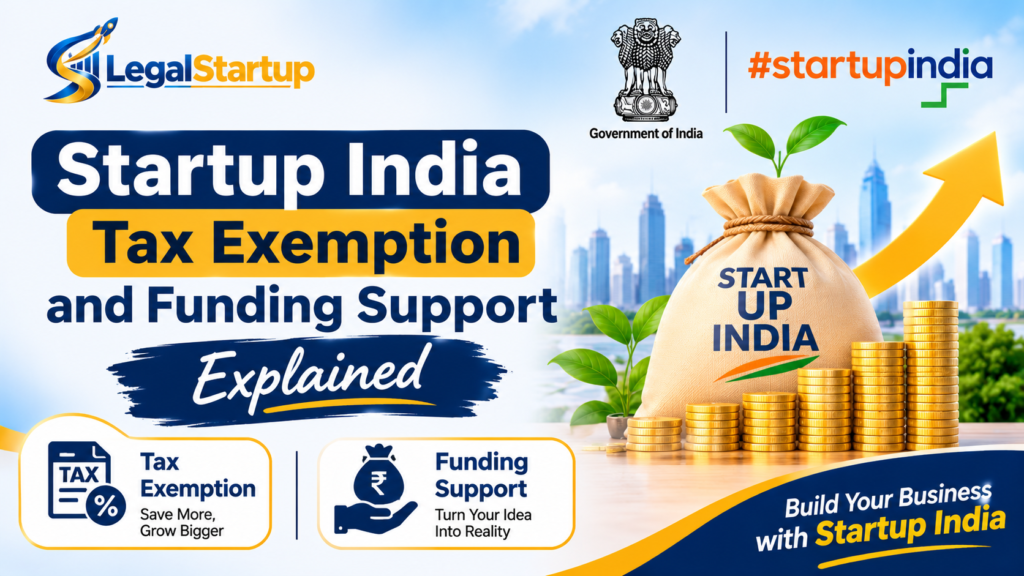
Startup India Tax Exemption and Funding Support Explained
How the Tax Holiday Works
The tax holiday is conditional. Treat it as one of the conditional Startup India benefits, not a default entitlement. To claim it, a startup generally needs to:
- hold DPIIT recognition and the IMB certificate;
- be a private limited company or LLP;
- be incorporated on or after 1 April 2016 and before 1 April 2030;
- stay within the turnover ceiling set for the claim year, which has been revised under the new Act, so verify the current figure on the Income Tax Department website;
- earn profits from the eligible business and furnish the prescribed audit report.
Example: A private limited company is incorporated in 2026-27 and starts making profits in its third year. It can choose years three, four and five for the deduction, because the three years must be consecutive but need not be the first three.
Not every recognised startup receives this exemption, which is why Startup India tax exemption is judged separately from recognition. Our team can walk you through the application on the Startup India registration page.
Funding Support
Funding is where Startup India benefits are most often misunderstood. The government does not hand out money to every recognised startup. It offers structured channels:
- Startup India Seed Fund Scheme: supports early-stage startups through incubators, with grants for proof of concept and prototype work and investment-linked support for market entry.
- Fund of Funds for Startups: government capital goes into SEBI-registered funds, which then invest in startups. You pitch to those funds, not to the government.
- Credit Guarantee Scheme for Startups: lenders can extend loans with a guarantee cover, reducing the need for collateral.
Amounts, sector focus and windows change over time, so check the official Startup India portal before you apply.
Startup India Registration Process (Step by Step)
The Startup India registration process now runs through the National Single Window System (NSWS). The steps are simple, and understanding them helps you claim Startup India benefits sooner.
- Incorporate first. Register a private limited company or LLP with the Ministry of Corporate Affairs, or confirm that your partnership firm is registered.
- Create an NSWS account. Visit nsws.gov.in, choose Investor Login and sign up.
- Add the startup form. On the dashboard, select Central Approvals and add “Registration as a Startup”.
- Fill in the details. Complete your entity profile, upload documents and write a clear description of your innovation or scalability.
- Submit and track. Watch the status on the dashboard and answer any DPIIT query quickly. Incomplete applications can be rejected after repeated rounds.
- Download the certificate. The digital certificate carries your DPIIT number. After that, apply separately for the tax holiday or other benefits you want.
The official DPIIT recognition page explains each stage in detail.
Documents Required
Keep these ready before you start. This one step saves most of the back-and-forth that slows down the Startup India registration process:
- Certificate of incorporation, or registration documents for partnerships and cooperatives
- PAN of the entity
- Details of directors, partners or authorised signatory
- A clear write-up of what your business does, what is innovative about it and how it can scale
- Website link, pitch deck or product video (helpful, not always mandatory)
- Annual accounts, where you also apply for the tax exemption
- Patent, trademark or R&D documents if you claim IP rebates or Deep Tech status
Common Mistakes to Avoid
- Assuming everything is automatic. Not all Startup India benefits start with the certificate. The tax holiday and funding need separate steps.
- Applying as a sole proprietor. Incorporate or register as an eligible entity first.
- Writing a vague business description. “We sell clothes online” says little about innovation. Explain what is new in your product, process or model.
- Ignoring age and turnover limits. Check both against the 2026 thresholds before applying.
- Following outdated articles. Anything written before February 2026 may quote the old ₹100 crore limit and miss Deep Tech and cooperative recognition.
- Missing the incorporation window for the tax holiday. The deduction applies only to startups incorporated before 1 April 2030, and delays in planning can cost you Startup India benefits worth lakhs.
- Neglecting annual compliance. Recognition does not replace ROC, GST and income tax filings.
Frequently Asked Questions
What are the benefits of Startup India?
Startup India benefits include free DPIIT recognition, a possible three-year tax holiday, abolition of angel tax, 80% off patent fees, 50% off trademark fees, self-certification, procurement relaxations and eligibility for funding schemes.
Who is eligible for Startup India registration?
Private limited companies, LLPs, registered partnership firms and cooperative societies up to 10 years old, with turnover not above ₹200 crore in any year since incorporation, and a business working on innovation or a scalable model. Deep Tech startups get 20 years and a ₹300 crore limit.
Is DPIIT recognition free?
Yes. The government charges no fee for the certificate that unlocks Startup India benefits. Professional fees, if you hire help, cover preparing your application and documents.
How can I get Startup India recognition?
Incorporate an eligible entity, create an account on nsws.gov.in, add the “Registration as a Startup” form, upload your documents and submit. The certificate is issued digitally.
Does Startup India provide tax exemptions?
Yes, but conditionally. Among all Startup India benefits, the tax holiday is the one that needs separate IMB approval, and only eligible companies and LLPs incorporated before 1 April 2030 qualify
What is the difference between Startup India and MSME registration?
Startup India (DPIIT recognition) targets innovative, scalable ventures and offers tax, IP and funding benefits. MSME (Udyam) registration is based on investment and turnover and helps with loans, subsidies and tenders. A business can hold both.
Conclusion
The best way to use Startup India benefits is to treat them as a checklist, not a single prize. Begin with the right entity, get your DPIIT certificate, and then apply for the tax holiday, IP rebates and funding schemes that match your stage. Always read each benefit’s own conditions, because Startup India benefits differ in eligibility and timing.
With the revised 2026 framework, more founders qualify than before, but wrong assumptions still cost time and money. A careful application with a clear innovation story is the surest way to unlock Startup India benefits without delays. Pairing recognition with GST registration and MSME registration gives you a solid compliance base from day one.
Planning to start your business in India? LegalStartup can help you with Startup India registration, DPIIT recognition and essential business registration services. Contact our team today for professional assistance.


